Life
Baltimore, the Kenton band, Don Ellis and four decades at Towson. Every entry is sourced, and the red markers are where my story crosses his.
Timeline, 1927 to 2026
Henry Jacob Levy is born in Baltimore on September 27. He grows up on Barrington Road on Sousa marches and Tommy Dorsey broadcasts, and finishes his first composition by age twelve.
Sources: Army Field Band booklet; Baltimore Sun obituary- 1940s
Still in high school, he joins Ken Hanna’s band, filling chairs left by musicians called up for World War II. Hanna, a former Kenton trumpeter and arranger, brings him Kenton manuscripts: “what a kick it was.” He graduates from Baltimore City College.
Sources: Army Field Band booklet; Baltimore Sun obituary Musician in the U.S. Navy. Back home, he works in the family business, the Independent Beef Company, writing scores between customers (“Just let me finish one more score page”). He spends a year at Peabody.
Source: Army Field Band bookletVisiting Ken Hanna in Los Angeles, he brings charts to a Kenton rehearsal at the Palladium. Baritone saxophonist Bob Gioga gives notice on the spot, Hanna points at Hank, and he plays a coast-to-coast CBS broadcast on a borrowed horn. He spends about six months on the band.
Source: Army Field Band bookletHe writes “Passacaglia and Fugue” out of self-study in classical composition. It later becomes the first Levy piece Don Ellis records.
Source: Army Field Band bookletFirst commission: Sal Salvador’s all-brass big band in New York, and the thrill of hearing his music recorded for the first time.
Source: Army Field Band booklet- 1960s
Kenton’s Adventures in Time, plus study of Bartók and Stravinsky, push him toward odd meters. He forms a rehearsal band to try them out.
Source: Army Field Band booklet His lead trumpeter Glenn Stuart, now playing for Don Ellis, tells him: “You and Don are experimenting along the same lines.” Hank writes for the Ellis band for the next ten years.
Source: Army Field Band bookletTowson State College hires him to build a jazz program from a ten- or eleven-piece stage band. Because he has no degree, he spends the next two years taking classes there too, often next to his own students.
Sources: Towson University; Army Field Band bookletKenton, who heard Hank’s Towson band play his Ellis charts at the Quinnipiac intercollegiate festival, takes up his music. Hank later called “Chiapas” the first piece he wrote for Stan, and the band recorded it live on Live at Redlands University (August 3–5, 1970). The partnership lasts until Kenton’s death in 1979.
Sources: Army Field Band booklet; All Things Kenton, RedlandsTowson wins outstanding band at the Notre Dame Collegiate Jazz Festival.
Source: WikipediaHank writes “Chain Reaction” (13/8) for Ellis’s orchestra with strings. Ellis records it on Connection in 1972. The Baltimore Symphony Orchestra premieres his Opus for Overextended Jazz Ensemble.
Sources: Army Field Band booklet; Wikipedia, Connection; Towson UniversityTowson releases its first jazz ensemble LP. On stage at Butler University, Kenton introduces Hank as the man behind “the time revolution in modern jazz.”
Sources: Towson University; HankLevyJazz.comDon Ellis records “Whiplash” on Soaring. Creative World publishes Hank’s book The Time Revolution, with an introduction by Kenton.
Sources: Army Field Band booklet; All Things Kenton bibliography- 1970s–80s
A run of Towson LPs, from 2 + 2 = 5 (1975) through 1989. When the chairman tells him “we do not want to be known as a jazz college,” Hank replies, “Sir, you are too late.”
Sources: Towson University; Army Field Band booklet I study composition with Hank at Towson State, as one of his last composition students.
Source: SeanFenlon.comHank retires from teaching at Towson. Sources differ on the year, and the Army booklet says 1991.
Sources: Towson University; Towson Special Collections; Army Field Band bookletOn February 25 he is named Professor Emeritus. The U.S. Army Field Band Jazz Ambassadors record The Legacy of Hank Levy at Fort Meade under his supervision. Hank’s notes for that album say “Chain Reaction” was selected for the Smithsonian Collection of Classic Jazz. We haven’t been able to confirm which edition.
Source: Army Field Band bookletDick Slade’s documentary A Head of Time: Ahead of Time.
Sources: Baltimore Sun obituary; Towson UniversityIn April the Towson University Jazz Ensemble releases With the Old Man in Mind, an all-Levy CD. Hank dies on September 18, aged 73. His wife Gloria died in 1996.
Sources: Baltimore Sun, Apr. 2001; Baltimore Sun obituaryMy dissertation, The Exotic Rhythms of Don Ellis, is dedicated to Hank: “Posthumous thanks to Hank Levy whose incredible musical influence introduced me to the music of Don Ellis.”
Source: Fenlon dissertationThe film Whiplash takes its title from Hank’s chart.
Source: Towson UniversityIn the year Hank would have turned 90, Towson formally honors him on April 13 with the Hank Levy Legacy Band and alumnus Drew Gress.
Source: Baltimore Sun, Apr. 2017AI recovers much of my long-inaudible microcassette interview with Hank about Don Ellis.
Source: DonEllisMusic.com interview
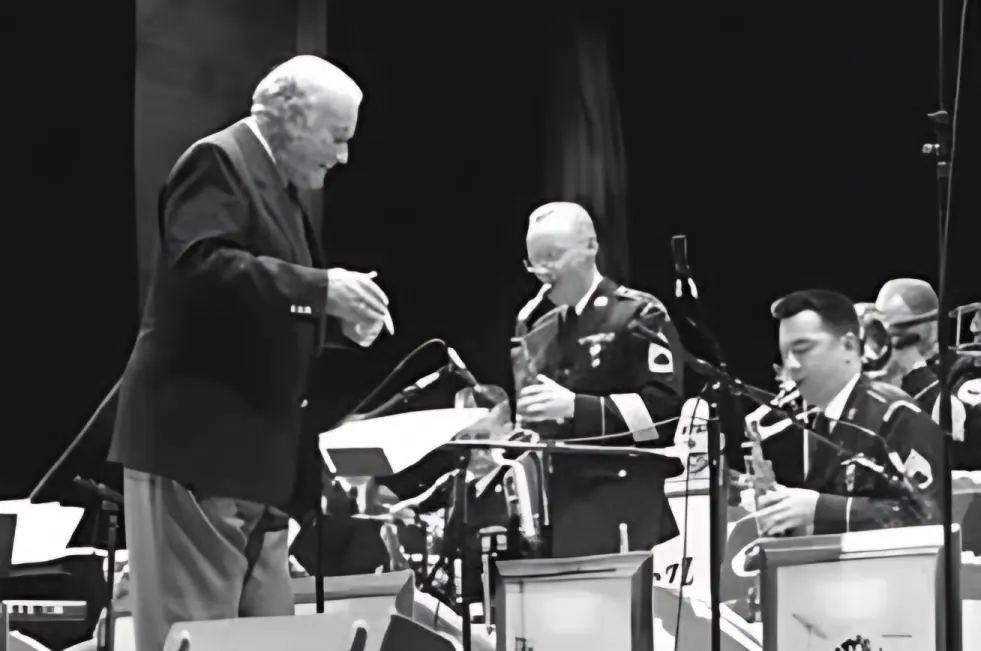
In his words
“I’m scared to death—I mean, look who’s on that stage: Lee Konitz, Bill Holman, Ritchie Kamuca, Frank Rosolino, George Roberts, Buddy Childers, Conti Candoli, Maynard Ferguson…and me!”Hank on his first night in the Kenton band, 1953 (interview with MSG Greg Reese, Feb. 20, 1997)
“I credit Don with opening me up. He always told me, ‘You gotta be prepared to stick your neck out every time you put pen to paper.’”Hank, program note for “Passacaglia and Fugue,” 1997